The New World as a Land of Freedom
The EmigrantsThe New World as a Land of Freedom is the imagined America Robert constructs from his reading and offers to Arvid as an alternative to the hierarchy and restricted mobility of rural Sweden. It turns dissatisfaction into a shared emigration plan: America appears to welcome people who are poor, oppressed, or bound to masters, and to promise equality, respect for work, and freedom to leave service. The voyage does not simply confirm the ideal. Robert soon discovers that life aboard ship has its own masters, rules, and confinement, setting the imagined refuge against the conditions of the crossing itself.
The book that makes America imaginable
Robert’s picture of America takes shape through the Description of the United States of North America, a small book hidden under the straw of his bed. Rinaldo had ordered it after Robert asked for a truthful account of North America; the schoolmaster advanced its price, and Robert read it three times over during the summer nights. He came to know its most important chapters almost by heart. While working on the dunghill, carrying a scythe, chopping straw, or sitting by the window, he mentally crossed the ocean. The country on the far shore grew in his imagination as steadily as a flower rising from dark soil.
The book’s distinction between an old and a new world gives his hopes a historical shape. The Old World appears frail, worn out, and bound to repetition: children follow their parents’ ways, and life in the old villages seems unable to change. The New World, by contrast, is young, recently settled, and full of riches and possibilities. Its emigrants are imagined as energetic people who have left their lords and masters behind. America becomes the destination not only of the ambitious but of those who are poor, harassed, sorrowful, hunted, or despairing. Robert’s conclusion is personal as well as general: America is right for him and for Arvid.
Freedom measured against farm service
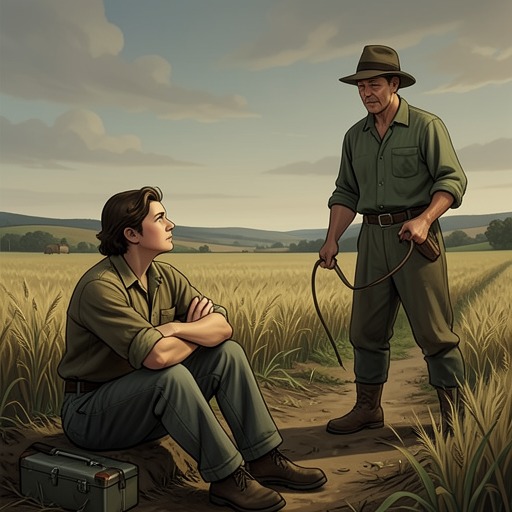
The ideal is grounded in Robert’s experience of work at Nybacken. Aron wakes him at four in the morning and urges him away from idleness; Robert is the youngest worker, and every member of the household can direct, hurry, correct, or scold him. The farm’s four horses add an unremitting round of feeding, grooming, stall-cleaning, and hauling water. The hired hand’s service year lasts 358 days, with only one free week. The animals are tied in their stalls, and the farmhands are tied to the animals: labor organizes both time and movement.
Robert’s account of America reverses that arrangement. He tells Arvid that hired men and maids there can leave service when they wish, without punishment, and that they need not work from early morning until late at night: the book says the working day does not exceed twelve hours. The contrast is especially sharp beside the Swedish servant law and the customary authority of the master. When Aron strikes Robert for laziness, Robert does not tell anyone; he understands the punishment as a master’s right under the servant law, reinforced by Dean Brusander’s teaching that a lazy servant should receive suitable chastisement. The scene shows how thoroughly authority has been made to seem legitimate to the servant, even as Robert’s imagined destination rests on escaping it.
The promised change extends beyond hours and the right to leave. In Robert’s report, America has no hereditary precedence of the kind he associates with Sweden, and no one must bow or curtsy to a superior. Work of every kind is accorded importance: a farmer with a thousand acres works alongside his hired men, unlike the local lieutenant, who owns much less land but does not join his workers in the field. Robert also insists that menial employment does not make a person an object of contempt. For Arvid, such equality addresses the shame and exclusion attached to the rumor about the white heifer and the name others use for him. In America, Robert reasons, no one would know the accusation, and Arvid could be regarded like other men.
A persuasive promise, not verified knowledge
Robert presents America through striking material comparisons as well as political ones. He says a good farmhand can earn 125 dollars a year, more than 300 riksdaler, while Arvid receives 40 riksdaler and a suit of wadmal for a year at Nybacken. In the book’s account, a year in America could thus bring more than six years of Arvid’s current pay. Food, too, is imagined in abundance: pork and white bread every day, double portions on Sundays, and no salt herring. Robert’s comparison makes even the pigs in the New World better fed than servants in Sweden.
These claims reach the reader through Robert’s enthusiastic retelling, not through an independent account of American life. He has read the book repeatedly and trusts its assurance that it offers clean, honest truth; as he speaks, however, he may add a little or leave a little out. The narrative makes clear the difference between the certainty of his belief and what his experience can verify. The country’s equality, good wages, food, and freedom are at this stage an image drawn from a book and sharpened by the deprivation Robert knows. That image is powerful enough to guide action, but it is not yet a description tested by life in America.
From ideal to shared departure
Arvid accepts the proposal immediately. America offers escape not only from exhausting farm service but from a reputation that has narrowed his place in the parish. Robert and Arvid shake hands and agree to cross the ocean together; later, they plan their emigration by lamplight in the stable room, keeping their deliberations secret from everyone except the bedbugs in the walls. The dream has become a practical intention shared by two companions, though their understanding of the destination still rests on Robert’s reading and their hopes.
The wider migration also reveals the limits and costs of turning the ideal into a journey. The Nilsson family’s old oak clothes chest, once used for clothing and household valuables at baptisms, weddings, and funerals, is brought down from the attic and made into a packing case. In it they place tools, a disassembled muzzle-loader, fishing gear, clothing, bedding, and food for the journey. The family chooses what can fit into a limited load, leaving behind familiar implements Kristina expects to miss. Departure is therefore not a simple passage from want to plenty: the emigrants must carry their means of work and household life with them, while surrendering much of what cannot travel.
The parting from Korpamoen gives the break with the old world a human and generational form. As the wagon leaves, Karl Oskar looks back at Nils and Märta standing together on the porch while the younger family departs. The old parents remain rooted at home; the emigrants move toward the future they have imagined. The image does not establish that America will fulfill every promise, but it shows what the ideal has already made possible: departure from inherited circumstances, even when that departure means leaving parents and familiar life behind.
The crossing tests the promise
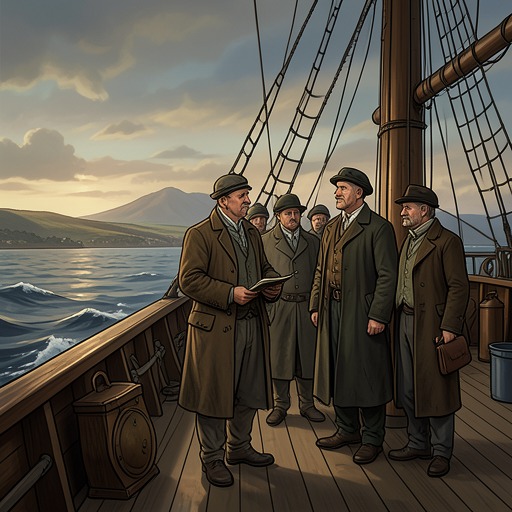
Aboard ship, freedom is immediately narrowed by collective regulations. The mate allocates unprepared provisions by the week, requires families to take turns at the galley, and sets limits on water; passengers must clean the hold before receiving their daily water and obey rules intended to protect the ship. Such arrangements are not the same as farm service, but they make the migrants’ movement and daily routines subject to shipboard authority. The practical necessities of passage complicate the image of an unrestricted new life before the emigrants have even reached land.
After one week at sea, Robert’s judgment turns. Seamen climb the masts, keep watches, and cannot fully rest; in the forecastle they lie packed close together, and they cannot step outside the ship’s rail. Robert compares their quarters unfavorably even with the stable room at Nybacken, despite its bedbugs. He finds the food worse than a farmhand’s salt herring and measures the ship’s confines as forty steps long and eight wide. His conclusion is that a farmhand on land has more freedom than a seaman at sea. This reversal does not erase his hope for America, but it separates the destination from the passage: the New World remains an ideal of release, while the route toward it temporarily recreates dependence and enclosure.
The book’s vision is thus both motive and measure. It gives Robert and Arvid a language for naming what is wrong with the hierarchy at home, and a reason to believe a different life might be possible. The crossing then tests the ideal against actual conditions, distinguishing freedom as a promise about the new land from the regulated, confined labor of reaching it. The distance between those two experiences is central to the concept’s force: America draws the emigrants forward, but it does not make the journey itself free.